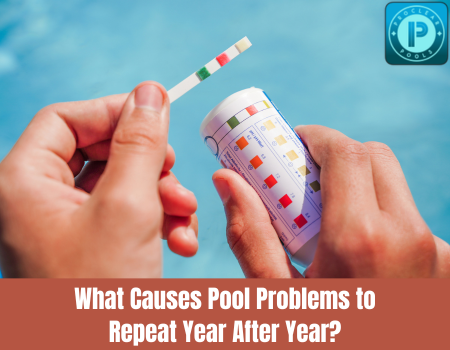
 Pool problems that keep coming back aren’t random. The green water that appears every July, the algae that establishes in the same corner every time, the equipment that fails on the same schedule regardless of when it was last replaced — these patterns have causes that repeat because the conditions producing them haven’t changed. Treating the symptom without addressing the condition is what produces the cycle that makes pool ownership feel like a constant battle rather than a manageable maintenance routine.
The recurring pool problems that Arizona pool owners experience most consistently fall into a short list of underlying causes that are findable and fixable rather than inevitable.
Common Recurring Pool Problems
Chemistry That Gets Corrected Rather Than Managed
The difference between a pool with stable chemistry and one that oscillates between pool problems is usually the difference between management and correction. A pool that gets tested when something looks wrong, treated to address the immediate pool problem, and then left until the next visible issue develops is a pool that’s always recovering from the last event rather than maintaining the baseline that prevents the next one.
Stabilizer level is the chemistry variable that creates the most persistent recurring problems when it runs outside the effective range, and nobody checks it specifically. A pool that keeps losing chlorine faster than it should, that requires constant chemical additions to maintain any sanitizer residual, and that turns green in the same conditions every year often has a stabilizer level that’s either too low to protect chlorine from UV degradation or too high to allow chlorine to work effectively. Neither condition announces itself as a stabilizer problem. Both produce recurring chemistry failures that get treated as chlorine problems without the actual cause being addressed.
pH drift is the recurring chemistry issue that compounds with everything else. High pH reduces chlorine effectiveness, accelerates calcium scale formation in Arizona’s hard water, and produces the combined conditions that allow algae to establish in a pool that tests as adequately sanitized. A pool that keeps developing algae despite what appear to be adequate chlorine levels has often been running at elevated pH long enough that the chlorine present isn’t working at the efficiency the test kit suggests.
Circulation Patterns That Don’t Change
The corner where algae establishes every summer, the floor area that collects debris regardless of how recently it was vacuumed, and the step surface that develops biological growth between service visits – these are circulation dead zones that the return jet pattern isn’t reaching effectively. Brushing these areas addresses the visible symptom. The circulation pattern that allowed the problem to establish continues producing the same result on the same schedule.
Return jet positioning is the circulation variable that gets set at installation and rarely adjusted afterwards. Jets that produce circulation near the returns and stagnation elsewhere create the predictable dead zones where recurring problems develop. Adjusting return jets to angle slightly downward and in a consistent rotational direction around the pool creates a circulation pattern that moves the full water volume toward the skimmer rather than churning water near the returns. This adjustment costs nothing and changes the recurring problem pattern in ways that chemical treatment alone doesn’t.
Pump runtime that was adequate in May becomes inadequate in July when water temperatures rise, algae growth conditions intensify, and the filtration demand increases. A pump running the same daily hours regardless of season is providing seasonal maintenance during the months that require peak maintenance, and the problems that develop in peak summer often reflect runtime that stopped being adequate as conditions changed.
Equipment That Gets Replaced Without Assessment
A pump motor that fails and gets replaced without understanding why it failed is a pump motor that’s likely to fail again on the same timeline if the conditions that shortened the first one’s lifespan haven’t changed. Blocked ventilation on the equipment pad, inadequate shade over the equipment, and a pump running extended hours against a filter that’s past peak performance — these are the conditions that age equipment faster than it should age, and replacing the equipment without addressing the conditions is expensive maintenance rather than problem-solving.
Filter media that degrades and gets replaced on the same schedule, regardless of what the operating conditions have been producing, is filter media that may be replaced too early in some seasons and too late in others. A filter in a pool surrounded by trees handling a heavy organic load degrades faster than the same filter in a pool with minimal debris input. Replacing media on a calendar rather than on an assessment of what the media is actually doing produces inconsistent filtration performance rather than consistent maintenance.
The Pattern That Produces Resolution
Recurring pool problems resolve when the conditions producing them are addressed rather than when the symptoms are treated more frequently or more aggressively. The algae that keep coming back in the same corner need a circulation change, not a stronger algaecide. The chemistry that keeps falling out of range needs stabilizer assessment, pH management, and runtime adjustment, not more frequent chemical addition. The equipment that keeps failing needs an assessment of the operating conditions it’s been working against, not just replacement with the same product installed under the same conditions.
Arizona’s operating environment amplifies every condition that allows recurring problems to develop — the heat that accelerates chemistry depletion, the UV that destroys chlorine, the hard water that precipitates calcium, and the dust storms that load filters faster than standard intervals expect. The pool maintenance program that accounts for these conditions, rather than applying generic national guidance, produces a pool that doesn’t fight the same battles on the same schedule year after year.
The CDC’s pool water quality resources cover how chemistry imbalances produce recurring water quality problems, what maintenance approaches address the underlying conditions rather than just the visible symptoms, and what the difference between reactive and preventive pool care looks like from a public health and water safety perspective — authoritative context that supports the article’s core argument about why treating symptoms without addressing conditions produces the recurring problem cycle.